|
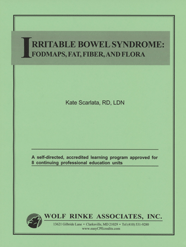
Irritable
Bowel Syndrome: Fodmaps, Fat, Fiber and Flora
Kate Scarlata, RD, LDN
| C226 |
8 CPEUs |
HARD COPY |
|
|
| C226E |
8 CPEUs |
ELECTRONIC |
|
|
|
Manual with 1 reporting form 85 pgs.
This up-to-date program will enable you to help your
clients manage their IBS symptoms. More specifically you will learn
how to:
- Assess symptoms and discuss treatment options for your clients with
IBS.
- Distinguish between food allergy, food sensitivities, gluten sensitivity
and celiac disease.
- Recommend a low FODMAP diet for symptoms management when appropriate.
- Develop IBS nutrition care plans with patient tolerable fiber-rich
foods and supplements.
- Create menu plans and grocery lists to assist IBS clients in lifestyle
management.
For more information and customer comments, click
here.
Approved by CDR, CBDM
For RDs/RDNs & DTRs/NDTRs for the Professional Development
Portfolio:
SUGGESTED Learning Need Codes:
3000, 3100, 4000, 4170, 4180, 5000, 5110, 5200, 5220, 8090
SUGGESTED Performance Indicators (PIs):
6.3.11, 8.1.5, 8.2.1, 8.2.3, 8.3.1, 8.3.6, 8.4.4, 10.2.7, 10.2.9, 12.4.6
DON'T SEE your Performance Indicators or Code Listed here?
There are many Performance Indicators (PIs) that are applicable we can't list them all &
Per CDR you may use ANY PI or CODE as long as it relates to your Learning Plan.
For details click here.
Irritable
Bowel Syndrome: Fodmaps, Fat, Fiber and Flora
Kate Scarlata, RD, LDN
©2012 Wolf Rinke Associates. All rights reserved
for this self-directed, accredited learning program. Reproduction in
whole or part without written permission from the publisher is prohibited.
CUSTOMER COMMENTS
Bonnie Morgan: “The FODMAPS Checklist, as well as various other charts with helpful information, e.g., FODMAP challenges, fat-saving substitution, caffeine content of drinks/food, fiber & probiotic/supplement information.
Mary Ryan: “Detailed information about how to apply course material, included evaluation of alternative approaches used in IBS, answered questions about FODMAPs not found in other educational sources I have consulted.”
Sharlyn Huber: “I definitely feel like I learned something from this course and will be able to refer to the study book when necessary.”
Amy Shapiro: “Information organized well, questions in application format a good way to assess knowledge.”
Kathleen Curry: “This course was exceptionally well-written; answered many questions I have had on this subject.”
Laura Bailey: “Useful information in a easy format to read.”
Carole Vecchry: “Excellent overview of IBS and FODMAPS.”
INTRODUCTION AND OVERVIEW
Irritable bowel syndrome (IBS) is classified as functional gut disorder
(FGD) characterized by symptoms of chronic, episodic abdominal pain,
altered bowel habits, bloating, sensation of incomplete bowel movement,
straining and/or urgency which is not explained by structural abnormalities.
IBS is a highly prevalent condition in North America estimated to impact
10-15% of the population (Saito 2002). As a chronic condition it presents
with almost one-third of patients experiencing symptoms for an average
of 10 years (Hahn et al. 1990).
In Chapter 1, you will learn about the pathophysiology, pathogenesis
and diagnostic criteria of irritable bowel syndrome. In Chapter 2, the
FODMAPs approach examines how these fermentable fibers and sugars contribute
to IBS symptoms. You will learn how to identify foods containing these
poorly absorbed FODMAPs. Chapter 3 will focus on different fibers and
their role in IBS. Chapter 4 reveals the physiologic role of fat in
stimulating the gastro-colic reflux and intestinal motility. The impact
of co-morbid conditions associated with fat malabsorption will be further
elucidated. Review of the digestive process will unfold in Chapter 5
with an introduction to key strategies to enhance digestion and minimize
malabsorption. Dietary indulgences such as alcohol, caffeine, and chocolate
can wreak havoc on the gastrointestinal track as detailed in Chapter
6. The basics to help clients manage their IBS symptoms in their everyday
life including grocery shopping, menu planning, traveling, and exercise
will be reviewed in Chapter 7. Appreciating the role of bacterial gut
flora and their potential role in irritable bowel syndrome will be covered
in Chapter 8, in addition to pharmaceuticals, herbal remedies, and cognitive
strategies.
This learning program is a level 2 Continuing Professional Education
(CPE) program approved for eight (8) continuing professional education
units (CPEUs). That means that the reader has general knowledge of literature
and professional practice in the area covered. The focus of the program
is to enhance knowledge and application.
To get the most benefit from this program, we suggest you adhere to
the following four steps:
Step 1: Review the objectives for the learning program.
Step 2: Study each chapter. As you read, think of patients from your
own practice that fit the situation described.
Step 3: Assess what you have learned by completing the self-assessment
instrument at the end of this learning program.
Step 4: Compare your answers to the answer key that has been provided.
If you score at least 80% correct, you are ready to transfer your answers
to the CONTINUING PROFESSIONAL EDUCATION REPORTING FORM. If you scored
less than 80% correct, re-read this learning program until you score
at least 80% correct.
After you have successfully completed the program complete the CPEU
REPORTING FORM and:
Mail to: Wolf Rinke Associates, 721 Valley Forge Road #486, Valley Forge, PA 19481,
Or fax to: (410) 531-9282,
Or submit on-line at www.easyCPEcredits.com.
We will email your Certificate of Completion.
When you submit your CPEU Reporting Form to us via mail, fax, or www.easyCPEcredits.com
be sure to write your correct email address in the space provided on
the CPE Reporting Form. If writing by hand, be sure to print your email
address clearly.
To ensure that our emails are delivered to your inbox (instead of your
junk/spam folders), please add cpesupport@wolfrinke.com to your Address
Book or Safe List of allowed email senders. Also, be sure to allow attachments
from this email address.
HAPPY LEARNING!
OBJECTIVES
Upon completion of this accredited, self-directed learning program
you should be able to:
- Identify the physiological abnormalities present in the IBS body.
- Recognize the diagnostic criteria for IBS.
- Assess symptoms and discuss treatment options for your clients with
IBS.
- Determine if other co-morbid conditions may be impacting symptom
management.
- Distinguish between food allergy and food sensitivities.
- Identify the difference between gluten sensitivity and celiac disease.
- Detect FODMAP sources in the diet.
- Recommend a low FODMAP diet for symptoms management when appropriate.
- Assess how different fibers impact IBS symptoms and management.
- Develop IBS nutrition care plans with patient tolerable fiber-rich
foods and supplements.
- Specify consequences of malabsorption on nutritional status.
- Explain the digestive process.
- Recommend key strategies to maximize digestion.
- Evaluate the impact of alcohol on the gastrointestinal tract.
- Identify caffeine sources and explain their impact on symptom management.
- Specify the potential role of chocolate and alcohol as IBS triggers.
- Counsel patients on the role of probiotics for their condition.
- Create menu plans and grocery lists to assist their IBS clients
in lifestyle management.
TABLE OF CONTENTS
Chapter 1. Irritable Bowel Syndrome: Diagnosis and Classification
PHYSIOLOGICAL ABNORMALITIES IN THE IBS GUT
IBS: PATHOGENESIS
GENETICS/ENVIRONMENT
MICROBIOTA ALTERATIONS
Small Intestinal Bacterial Overgrowth (SIBO)
Risk factors
Diagnosis and nutritional consequences
SIBO treatment
INFLAMMATORY CONDITIONS
BRAIN/GUT RELATIONSHIP
SEROTONIN DISRUPTION
FOOD ALLERGIES VS. INTOLERANCE
CELIAC DISEASE AND NON-CELIAC GLUTEN SENSITIVITY
IBS DIAGNOSTIC CRITERIA
Manning
Rome
RED FLAG SYMPTOMS
Chapter 2. FODMAPs: Efficacy and Basis for Use in IBS
DIET SOURCES OF RAPIDLY FERMENTABLE CARBOHYDRATES
Lactose
Fructose
Fructans
GOS
Polyols
THE FODMAPS APPROACH
Got lactose intolerance?
Fructose malabsorption
FODMAPS IN OUR FOODS
SAVVY LABEL READING
REINTRODUCTION OF FODMAPS
LIMITATIONS OF USE
Chapter 3. Fiber: Friend or Foe in IBS
HEALTH BENEFITS OF FIBER
SOLUBLE VS. INSOLUBLE FIBER
MAXIMIZING FIBER WITHOUT FODMAPS
SUPPLEMENTS
Chapter 4. Role of Fat in IBS
FATS IN HEALTH
CO-MORBID CONDITIONS IMPAIRING FAT DIGESTION
DETERMING FAT LIMITS
HIDDEN FATS
MODIFYING FAT INTAKE
Choosing lower fat food sources and recipe replacements
Low fat cooking
Chapter 5. Digestion 101
THE DIGESTIVE PROCESS
FOOD TO DIGESTIBLE COMPONENTS
MALDIGESTION
MINIMIZING AIR INGESTION
MIGRATING MOTOR COMPLEX
Chapter 6. Dietary Indulgences: Impact of Alcohol, Caffeine and Chocolate
ALCOHOL'S IMPACT ON THE GASTROINTESTINAL TRACT
FODMAPs and drink choices
CAFFEINE
Impact on intestinal motility
Caffeine sources in the diet
CHOCOLATE
Fiber content
Chocolate as a caffeine source
Fat content
Chapter 7. IBS Lifestyle Solutions
GROCERY SHOPPING
MENU PLANNING
SNACKS
DINING OUT
TRAVELING
EXERCISE
Chapter 8. Beyond Diet: Probiotics, Supplements and Medications
PROBIOTICS
Types of probiotics
Role of probiotics in IBS
Use in SIBO
Prebiotics
PHARMACEUTICALS
HERBAL THERAPIES
COGNITIVE STRATEGIES
Summary
References
List of Abbreviations
Glossary
Resources
Self-Assessment Questions
Explanation to Questions
About The Author
About Wolf Rinke Associates, Inc.
ABOUT THE AUTHOR
Kate Scarlata is a registered and licensed dietitian with a Bachelor
in Science from Simmons College in Boston, Massachusetts. Her postgraduate
training was completed at Brigham and Women's Hospital, a Harvard Medical
School teaching affiliate. As a digestive health expert, Kate has authored
The Complete Idiot's Guide to Eating Well with IBS and many digestive
health focused articles. In addition to her health writing, Kate provides
nutritional consultation in her private practice in Boston, Massachusetts.
Return to the top of page
If you prefer to order by phone, mail
or fax click below
or click here to contact us with
other questions.
For information about our other products and
services return to the sidebar at the top of the page.
|
|
|